
The SAMR Model at the Substitution Level

General Overview of SAMR:
SAMR is a model developed by Dr. Ruben R. Puentedura to frame the use of technology in the classroom/learning environment. SAMR stands for Substitution, Augmentation, Modification and Redefinition.
- SUBSTITUTION: Technology acts as a direct tool substitute, with no functional change.
- AUGMENTATION: Technology acts as a direct tool substitute, with functional improvement.
- MODIFICATION: Technology allows for significant task redesign.
- REDEFINITION: Technology allows for the creation of new tasks, previously inconceivable.
The SAMR Model was introduced by Ruben Puentedura in 2006 in collaboration with the Maine Department of Education and their learning technology initiative. The model describes the life cycle of technology integration. It is a good framework to refer to when reflecting on how well we use technology to enhance learning. https://digitallearningteam.org/2012/06/07/the-samr-model-enhancing-technology-integration/
For more information on the SAMR model in general, visit Dr. Ruben R. Puentedura’s blog at: http://www.hippasus.com/rrpweblog/
The Substitution Level:
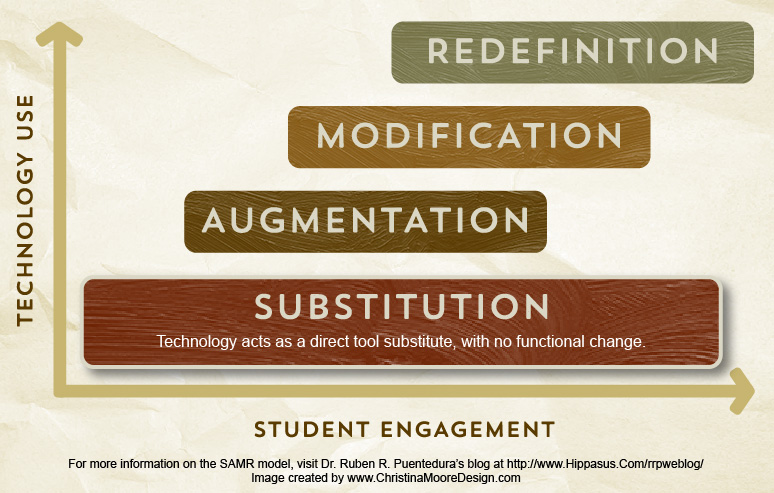
At the Substitution level of SAMR, technology is acting as a direct tool substitute. Substitution is the first, and most basic level of bringing technology into the classroom. You can think of Substitution as a basic tool upgrade. While it can save the teacher and student considerable time, it is a low level of technology use and student engagement. Most current instructors embrace and utilize the Substitution level, as much as possible. Smart phones, tablets, desktop computers, web sites and software can go a long way to help instructors save time, and have a more meaningful interaction with their students.
Here are some examples of Substitution in the classroom that I brainstormed:
- Using Word or Google Docs, instead of writing an assignment
- Using Powerpoint or Keynote, instead of verbal presentation
- Sketching on a computer, instead of on paper
- Reading a paper or book on a device, instead of a printed book
- Taking a quiz online, rather than printed
- Coloring in the United States online, rather than a coloring book
- Watching a video of sports instruction, rather than watching an instructor in person
- Journaling in a Google doc, rather than writing in a paper journal
- Taking notes on an iPad, rather than on paper
- Emailing an assignment, rather than handing it in physically
For more ideas on how SAMR can be implemented through all four steps, check out this blog posting: http://www.emergingedtech.com/2015/04/examples-of-transforming-lessons-through-samr/
Pushback/Discrediting of the Substitution Level:
It has been suggested that Substitution, being the most basic application of technology to learning, can be lacking in student engagement and use of technology. Embracers of the SAMR model strive to move up the ladder in their use of technology in the classroom. The ultimate goal being to apply the Redefinition level within their learning environments. Conversely, I feel that simple technological substitutions in the classroom are not only crucial in this day and age, but of great value to both the teacher and the learner.
Here are some reasons why the Substitution level is a powerful tool in education:
- Reduces the carbon footprint, by reducing and/or eliminating paper and ink
- Makes the material accessible globally
- Saves time and resources for both student and instructor
- It’s the easiest level for the instructor to implement, and the student to participate with
- Students and instructors are familiar with this phase of SAMR, and it therefore provides a strong foundation upon which to build the learning process
While I chose to explore the Substitution level of SAMR, here are other links that will explain the other three steps of SAMR (Augmentation, Modification, and Redefinition).
For more information on each step:
- Augmentation by Alicia Newton: http://learningpathllc.wixsite.com/alicianewton/single-post/2017/02/07/SAMR-what
- Modification by Allison Sandler: https://mrssandler.com/2017/01/30/using-the-samr-model-at-the-modification-level/
- Redefinition by Kirk Lunsford: http://designingtolearn.blogspot.com/2017/02/vr-redefining-how-we-design.html
 Christina Moore Design